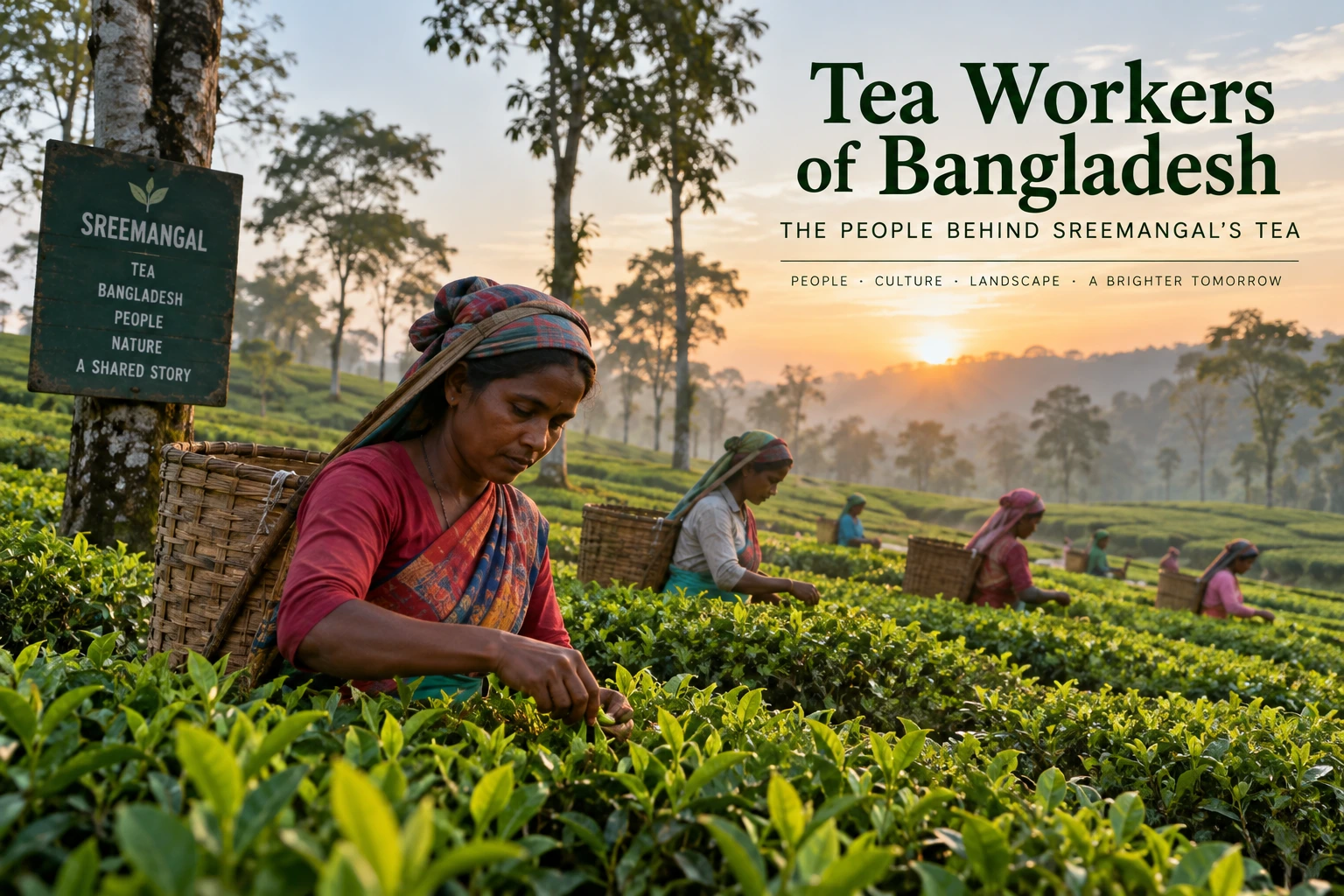
Before sunrise settles over the tea estates of northeastern Bangladesh, another working day begins. Footpaths weave between long rows of tea bushes, collection points prepare for the morning’s harvest, and workers make their way toward assigned sections of the estate.
Visitors often remember Sreemangal for its endless green landscape. Yet the scenery tells only part of the story. Every cup of tea depends on people who plant, prune, pluck, carry, sort and process the leaves. Many belong to tea-estate communities whose connection with the industry stretches across several generations.
Understanding a tea worker requires looking beyond photographs of baskets and green hills. The story involves colonial-era migration, diverse cultural identities, physically demanding work, women’s labor, community life and continuing conversations about education, healthcare, wages, housing and social protection.
For international travelers, visiting a tea-growing region can be meaningful—but only when curiosity is combined with consent, accuracy and respect. This guide introduces the tea workers of Bangladesh while explaining how travelers can experience Sreemangal without turning working communities into tourist attractions.
Who Are the Tea Workers of Bangladesh?
Tea workers are the people involved in cultivating and processing tea across Bangladesh’s tea-producing regions. Their work can include planting, plucking, pruning, removing weeds, maintaining the estate, transporting harvested leaves and supporting factory operations.
The term does not describe one ethnic group.
Bangladesh’s tea-estate population includes numerous communities with different languages, religions, traditions and family histories. Many workers’ ancestors were brought to the tea-growing regions during British colonial rule, often from areas that are now part of India.
Today, tea workers and their families primarily live in estate-connected residential communities in tea-producing areas such as Moulvibazar, Habiganj, Sylhet, Chattogram and parts of northern Bangladesh.
According to a 2024 International Labour Organization report, Bangladesh had approximately 100,619 tea workers across 159 tea gardens in seven districts. Around half of those workers were women. Because employment figures and estate operations can change, visitors and publishers should treat these as dated national estimates rather than permanent totals.
A Quick Overview for International Visitors
| Question | Practical answer |
| Where do most visitors encounter tea communities? | In the Sreemangal and greater Sylhet region, especially Moulvibazar District |
| Is “tea worker” an ethnic identity? | No. It is an occupational description covering several distinct communities |
| Can tourists freely enter tea estates? | Not necessarily. Many estates are privately managed working properties and require permission |
| Does estate permission equal community consent? | No. Permission to enter an estate does not automatically grant permission to photograph or interview residents |
| Are tea estates open year-round? | Operations continue through different seasons, but visitor access and visible activities vary |
| Can visitors photograph tea workers? | Only after obtaining clear, voluntary permission from the individual |
| Is a residential community a tourist attraction? | No. It is a place where people live and should be treated as such |
| What is ethical tea tourism? | A visit that respects access rules, informed consent, privacy, cultural dignity and fair local participation |
The History Behind Bangladesh’s Tea Communities
The expansion of tea under colonial rule
Commercial tea cultivation expanded in the Sylhet region during the nineteenth century under British colonial plantation systems. Large estates required a substantial and controlled labor force, but local recruitment did not meet plantation demand.
Colonial recruiters consequently brought laborers from different parts of the Indian subcontinent. Many came from economically vulnerable and Indigenous communities. Recruitment frequently involved misleading promises, coercive arrangements, debt and highly restrictive working conditions.
The journey into the tea estates was therefore not simply voluntary migration in the modern sense. It formed part of a plantation economy designed to secure inexpensive labor and limit workers’ ability to leave.
Workers were settled in estate-based residential areas historically known as labor lines. Employment, housing and access to basic services became closely connected to the plantation. That structure influenced generations of community life and continues to shape important debates about land, housing, employment and social protection.
From migration to multigenerational community life
Over time, migrant workers formed permanent communities around the tea estates. Families preserved religious observances, music, dance, food traditions and languages while also developing shared forms of communication and identity within the gardens.
Descendants of these workers are now citizens of Bangladesh. Many families have lived in the country’s tea regions for generations, although questions surrounding economic mobility and secure rights remain important.
It is inaccurate to portray tea workers as temporary outsiders. They are part of Bangladesh’s social, cultural and economic history.
Why careful historical language matters
Travel writing sometimes compresses this history into a cheerful narrative about “colorful tribal workers.” That description is both inaccurate and harmful.
It removes the colonial labor system from the story, groups distinct communities under a single label and reduces living people to visual decoration. Responsible storytelling should identify people as individuals or members of a specific community only when that information is known, relevant and shared with permission.
Tea Workers Are Not One Community
A diverse plantation population
Bangladesh’s tea-estate population includes dozens of communities. Reporting published in 2026 described approximately 30 to 35 distinct groups across the tea regions, although classifications and estimates vary among researchers.
Languages historically associated with these communities include Santali, Kurukh and Mundari. Sadri—sometimes described locally as a tea-garden language or Bagani Bhasha—has also served as a shared means of communication in some estates.
Language use differs by location and generation. Some community languages face pressure as younger residents increasingly use Bangla for education, employment and communication outside the estate.
Travelers should not guess a worker’s ethnicity, religion or language from appearance. A local guide with trusted community relationships can help provide context, but individuals must still be allowed to describe their own identities.
Culture is more than a performance
Tea communities maintain different festivals, belief systems, musical practices, dances, clothing traditions and food cultures. These traditions should not be treated as performances that automatically exist for visitors.
A community event may be open to guests, privately observed or arranged specifically for cultural exchange. Travelers should understand which situation applies before attending or photographing it.
If a tour includes a cultural presentation, ask whether community members chose to participate, determined how their culture would be explained and received direct compensation.
What Does a Tea Worker Do?
Plucking tea leaves
Hand-plucking is the most recognizable form of tea labor. Workers select suitable young leaves and buds according to production standards and place them in a basket or carrying sheet.
Although the movement may appear simple from a distance, consistent plucking requires speed, judgment and physical endurance. Workers may spend hours walking between rows, reaching across bushes and carrying an increasingly heavy harvest.
The work takes place in outdoor conditions that can include heat, rain, humidity, insects and slippery ground.
Women perform a substantial share of visible tea plucking in Bangladesh. Their contribution should not be romanticized as part of the scenery; it is skilled and physically demanding agricultural labor.
Weighing the harvest
At designated collection times, plucked leaves are taken to a weighing point. The amount collected is recorded before the leaves move to the next stage of production.
Weighing is part of a worker’s employment process, not a public demonstration. Visitors should remain at a respectful distance, avoid blocking movement and never interrupt workers to arrange photographs.
Photography at a collection point requires permission from estate management and the workers who are identifiable in the images.
Pruning and estate maintenance
Tea bushes require pruning to remain productive and manageable. Other tasks can include planting, clearing weeds, maintaining drainage, applying approved agricultural treatments and caring for estate paths.
These jobs may be less visible to tourists than leaf plucking, but they are essential to production. Tea work also changes with the season, meaning a visitor should not expect the same activities throughout the year.
Factory work
Fresh leaves must be processed quickly. Depending on the tea being produced, factory stages may include withering, rolling, oxidation, drying, sorting and packing.
Factories are controlled workplaces containing machinery, heat, dust and designated safety zones. Entry should occur only through an authorized visit. Visitors must follow instructions and should not assume that photography is permitted.
Women and the Tea Economy
Women form a major part of Bangladesh’s tea workforce, particularly in leaf plucking. However, their responsibilities may extend far beyond paid estate work.
A woman may complete a physically demanding workday while also managing cooking, water collection, childcare, elder care and household responsibilities. Focusing only on a visually attractive image of a woman carrying tea leaves can make this additional labor invisible.
Gender also affects access to education, healthcare, maternity protection, job advancement and representation in workplace decisions.
A 2025 consultation organized by the Centre for Policy Dialogue in Sreemangal reported concerns involving education, healthcare, safe drinking water, maternity support, skills training and wider social-protection coverage. These findings came from a specific consultation and should not be treated as proof that every worker or estate has an identical experience. They do, however, identify issues that deserve serious attention.
Ethical travel content should allow women to speak for themselves when they choose to do so. It should not use a worker’s portrait to create an emotional story that the subject never approved.
Livelihoods Beyond a Daily Wage
Public discussion about tea workers often focuses on the daily cash wage. Wage information is important, but it must be reported carefully.
Rates can change following negotiations or government and industry decisions. Employment categories, work targets, attendance, in-kind benefits and estate arrangements can also complicate simple comparisons. Any article stating a wage should include its source, geographic scope and publication date.
In August 2026, The Daily Star reported one worker referring to a daily wage of Tk 187. That is a dated, attributed example—not a universal or permanent rate for every tea worker in Bangladesh.
Livelihood conditions may also involve:
- Housing connected to estate employment
- Access to medical facilities of varying capacity
- Education opportunities for workers’ children
- Water and sanitation conditions
- Food or ration arrangements
- Seasonal and household income differences
- Limited alternatives outside estate employment
- Uncertainty over long-term housing or land security
A responsible article should neither hide these realities nor reduce an entire community to hardship. Tea workers are not only labor statistics. They are parents, students, musicians, athletes, organizers, craftspeople and citizens with different goals and opinions.
Why Conventional Tea Tourism Can Cause Harm
Tea tourism is often promoted through beautiful gardens, smiling portraits and promises to “meet the workers.” Problems begin when access to people is treated as part of a visitor’s purchase.
Paying for a tour does not purchase a worker’s time, story or image.
The power difference between a foreign visitor carrying an expensive camera and a worker at their workplace can make consent complicated. A person may agree because a manager, guide or group is watching—not because they genuinely want to participate.
Unethical visits can include:
- Entering residential areas without community agreement
- Photographing people before asking permission
- Encouraging children to pose during school hours
- Requesting workers to repeat actions for a photograph
- Interrupting production or weighing activities
- Photographing inside homes
- Using poverty-focused captions to attract attention
- Flying drones above homes or workplaces
- Asking intrusive questions about wages in public
- Distributing money or candy to children for photographs
- Presenting one person’s experience as the story of all tea workers
Ethical tea tourism starts by recognizing that a tea estate is simultaneously a workplace, a managed property and—within designated areas—a home.
What Ethical Tea Tourism Looks Like
Obtain permission at every level
Estate access and personal consent are separate requirements.
A responsible visit may require:
- Permission from the estate authority to enter working property
- Coordination with a trusted local guide or community contact
- Community agreement before entering a residential area
- Individual consent before photographing, recording or interviewing anyone
Permission from a manager cannot replace consent from the person being photographed.
Keep groups small
Small groups create less disruption and allow guides to explain context properly. They also make genuine conversation more possible than a crowd surrounding one worker.
Travelers should avoid peak work areas unless the visit has been coordinated. Paths, collection points and factory zones must remain clear.
Pay fairly for organized participation
When community members provide interpretation, demonstrate a craft or participate in a scheduled cultural exchange, the arrangement should include transparent compensation.
Payment should recognize their knowledge and time. It should not be framed as charity.
A responsible operator should be able to explain:
- Who designed the experience
- Whether participation is voluntary
- How contributors are compensated
- Whether the community can refuse or change activities
- How many visitors are allowed
- What photography rules apply
Buy directly when appropriate
Locally made products, food or crafts may provide an additional source of income, but purchases should take place through verified arrangements.
Do not pressure residents to sell private possessions. Avoid bargaining aggressively over small amounts, especially when buying something made by hand.
Let people control their stories
If someone agrees to an interview, explain where the story will appear and how it may be used. Do not promise publication, donations or future assistance unless you can genuinely deliver them.
For sensitive subjects, consider whether identifying the person could create workplace or social risk. Anonymous reporting may sometimes be more appropriate, but anonymity should be discussed with the contributor rather than assumed.
Ethical Photography in a Tea Plantation Community
Ask before raising the camera
The best practice is simple: establish communication before taking a recognizable photograph.
A guide can help translate, but the photographer should still look for a clear response from the subject. Silence, nervous laughter or looking toward a supervisor should not be interpreted as consent.
If someone declines, thank them and move on.
Take special care with children
A child cannot provide the same level of informed consent as an adult. Obtain permission from a parent or responsible guardian, and consider whether the photograph is necessary at all.
Never ask children to miss school, enter a work area, recreate labor or pose in unsafe surroundings. Do not exchange sweets or money for a child’s portrait.
Images connected with child labor require exceptional care, verification and editorial justification. A traveler should not label a child as a worker based only on where the child was seen.
Avoid poverty-centered composition
Photographs can create misleading narratives through framing and captions. An image of worn housing without context may encourage viewers to see an entire community only through deprivation.
Strong documentary work provides context, preserves dignity and avoids turning hardship into visual entertainment. Record names only with permission, verify captions and never invent emotional details.
Share images responsibly
If a worker asks for a copy, agree on a realistic way to provide it. A printed photograph, messaging application or delivery through a trusted local contact may work, depending on connectivity and consent.
Do not upload geotagged photographs of private homes. Avoid captions that describe someone as “poor,” “helpless,” “primitive” or “untouched.”
Travelers interested in more thoughtful documentary practice can combine an ethical tea-estate visit with a properly guided Street Photography Tour in Dhaka, where the same principles of consent, context and human dignity should apply.
How to Choose a Responsible Sreemangal Experience
Before booking, ask the tour operator direct questions.
Questions to ask the operator
- Does the estate authorize visitor access?
- Are residential areas included, and who approved the visit?
- Do workers or community representatives help shape the experience?
- Can residents refuse photographs or conversations?
- How are local contributors compensated?
- What is the maximum group size?
- Are children intentionally included in photography activities?
- Does the guide explain plantation history and present-day labor issues?
- Are visitors told not to enter homes or distribute gifts?
- What happens if estate operations or community preferences change?
Detailed answers indicate preparation. Vague promises that visitors can “photograph tribal life” should be treated as a warning sign.
International visitors planning a broader northeastern journey may consider a Sreemangal and Sylhet Tour, but they should confirm that any tea-community component follows these standards.
A shorter Sreemangal Tour from Dhaka can introduce the tea landscape and local history without requiring intrusive access to residential areas.
For information focused on estates, scenery and places to visit, read the separate guide to the tea gardens of Bangladesh. Keeping destination information on that page allows this article to remain focused on workers, community history and ethical tourism.
A Respectful Tea Experience for Foreign Visitors
A meaningful tea experience does not require walking through private homes or photographing people at close range.
A well-designed visit could include:
An introduction to the landscape
The guide explains why the region’s climate and terrain support tea cultivation, how an estate is organized and which areas visitors may enter.
Historical interpretation
Visitors learn how colonial plantation systems recruited and controlled labor, how communities developed around the estates and why this history still matters.
Observation without interference
From an approved location, visitors may observe cultivation or collection activities. The guide explains each process without stopping workers or turning the work into a performance.
A consent-based conversation
If community members have voluntarily chosen to participate, a scheduled discussion can cover family history, language, education, culture or changing employment. Contributors should be compensated for their time.
No participant should be pressured to discuss wages, discrimination or personal hardship in front of employers, managers or a large group.
Tea tasting and economic context
A tasting can connect agricultural labor with the finished product. Visitors can learn how leaf quality, processing and grading affect the tea they drink.
The experience should explicitly recognize the workers whose labor made that product possible.
Responsible local spending
Lunch at a locally owned restaurant, purchases from verified artisans and paid interpretation can spread visitor spending beyond accommodation and transport.
How International Travelers Can Help Without Acting as Rescuers
Visitors sometimes respond to inequality by offering unplanned donations. Good intentions can still create unintended consequences, especially when money or gifts are distributed to children.
More responsible actions include:
- Choose operators with transparent community practices
- Pay fairly for guiding, interpretation and cultural participation
- Purchase verified local products at fair prices
- Support credible organizations after conducting proper research
- Share accurate historical and cultural context
- Respect refusals and access restrictions
- Avoid “before and after” charity narratives
- Do not make promises that cannot be fulfilled
- Credit contributors when they request attribution
- Correct inaccurate captions or assumptions
Travelers should listen before deciding what a community needs. The goal is not to become the hero of someone else’s story.
Why the Tea-Worker Story Matters
Bangladesh’s tea industry is often represented by a landscape: bright leaves, rolling hills and mist over the estates. The landscape is real, but it is not self-producing.
Behind it are generations of labor and community life shaped by colonial history, cultural resilience, changing economic conditions and individual ambitions.
A people-centered understanding does not ask travelers to stop enjoying Sreemangal’s natural beauty. It asks them to see the complete picture.
The tea worker is not a background character in a tourist photograph. Every worker has the right to privacy, accurate representation and control over participation. Every community contains multiple voices, so no single interview or visit can represent all tea workers of Bangladesh.
Ethical tourism succeeds when visitors leave with greater understanding while the people they meet retain dignity, choice and meaningful benefit.
Frequently Asked Questions
Who are the tea workers of Bangladesh?
The tea workers of Bangladesh are people employed in tea cultivation, estate maintenance, leaf collection and processing. Many belong to multigenerational communities whose ancestors were recruited into colonial plantations from different regions of the Indian subcontinent. They represent several distinct ethnic, linguistic and religious groups.
Where do tea workers live in Bangladesh?
Tea-estate communities are found primarily in tea-producing districts, including Moulvibazar, Habiganj, Sylhet and Chattogram, as well as parts of northern Bangladesh. Sreemangal in Moulvibazar is the country’s best-known tea tourism gateway.
Are all Sreemangal tea workers from the same ethnic group?
No. “Tea worker” is an occupational description, not a single ethnicity. Bangladesh’s tea estates include many communities with different origins, languages, religions and cultural practices.
Can tourists visit a tea-worker community?
Only when access has been properly arranged. Estate authorization may be required, and the residential community must also agree to receive visitors. Entering an estate does not give tourists permission to enter homes, interview residents or take photographs.
Is it acceptable to photograph tea workers?
Yes, but only with clear individual consent and compliance with estate rules. Ask before taking the photograph, accept refusal immediately and explain any intended commercial or editorial use. Extra safeguards are necessary when photographing children.
What is ethical tea tourism?
Ethical tea tourism respects the tea estate as a workplace and community. It uses informed consent, protects privacy, minimizes disruption, compensates local participation fairly and explains both tea production and the history of plantation labor.
What is the best time to visit Sreemangal?
The cooler months from approximately November to February are generally comfortable for international travelers. Tea work and visitor access vary by season, estate and weather, so travelers should confirm conditions with a local operator before arriving.
Should visitors give money or sweets to children?
Unplanned distribution is not recommended. It can encourage unsafe interactions, create conflict and connect photography with payment. Visitors who want to contribute should consult a credible community organization or locally trusted representative.
How can travelers support tea communities?
Choose responsible operators, pay fairly for community-led activities, purchase verified local products, respect privacy and share accurate information. Any donation should go through a transparent and credible organization instead of being used to gain access or photographs.
Does visiting a tea estate help tea workers?
Not automatically. Benefits depend on how the visit is organized and where the money goes. A responsible experience should involve community choice, fair compensation, limited group sizes and clear consent procedures.